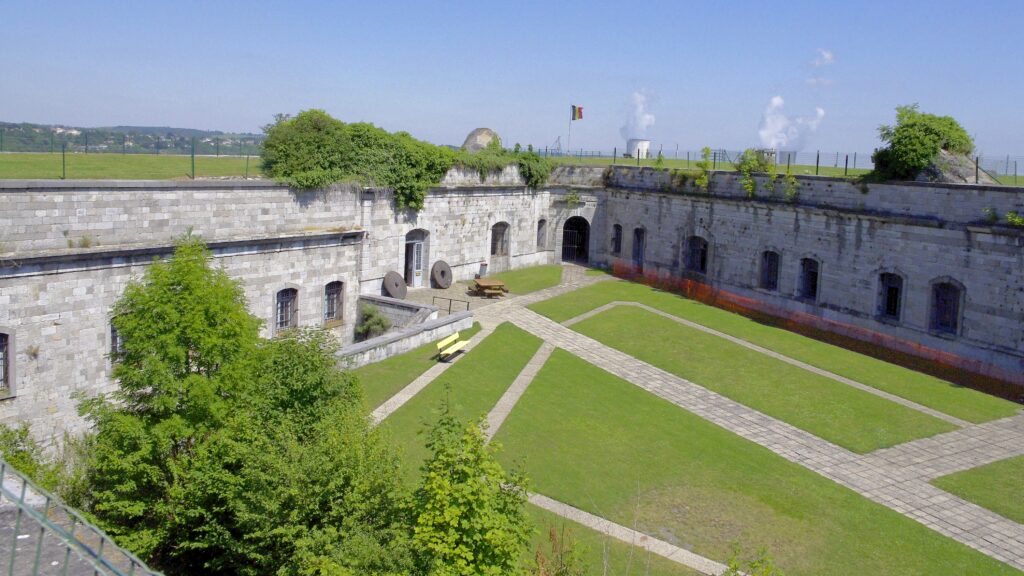
Fort Huy, built in 1818, is a fortress standing on the banks of the Meuse River in Wallonia. It overlooks the town of Huy, located in the province of Liège in Belgium. This imposing structure was built on the site of the former Tchestia, one of the “four wonders” of Huy.
Galerie photos
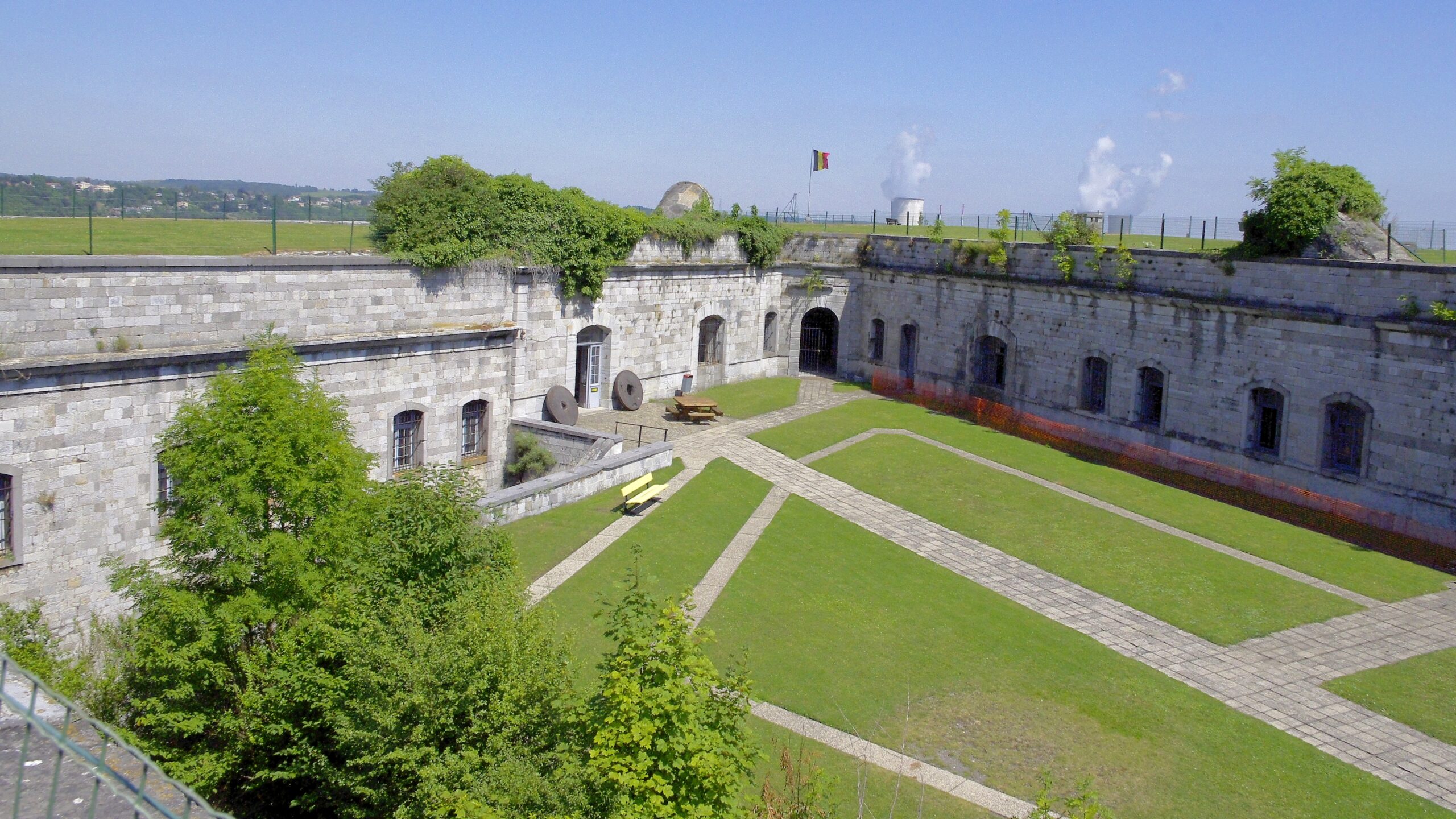
© Traumrune / Wikimedia Commons
History
Due to its strategic importance in the region controlling the Meuse Valley, the Dutch government decided in 1815 to build a fortress on the site. Under the direction of Lieutenant Colonel H. Camerlingh and with the supervision of Captain Engineer A. J. Anemaet, the first stone of the citadel was laid on April 6, 1818. Construction took five years to complete.
Despite this, the fortress built by the Dutch never fulfilled its military role. Instead, it was used as a political prison for republicans of the “Risquons-tout” movement in 1848. In 1876, the citadel was sold to the town of Huy, but was bought back by the Belgian state in 1880 to be reintegrated into the Meuse defensive system in 1914. From then on, the fort served as an internal disciplinary camp for the Germans.
After World War I, the fort was used to house Russian prisoners and later as a regimental school for the 14th Line Regiment. From 1932 onwards, the fort was converted into a tourist attraction, allowing visitors to enjoy a panoramic view of the town.
World War II
In 1939, German soldiers were interned at Fort Huy after crossing the Belgian border. On May 10, 1940, these soldiers were transferred as prisoners of war. Shortly thereafter, the fort was attacked by the Germans to free the prisoners, who had, however, already been transferred elsewhere. The Germans then used the fort as an internment center for political prisoners and hostages, under the administration of the Wehrmacht and led by Commander Frimberger. More than 6,500 patriots, including Guillaume Vermeylen, were interned there for various reasons, including resistance, banditry, black market activities, refusal to perform compulsory labor, hostage-taking, communism, strikes, etc. The fort also housed prisoners of various nationalities.
From July 1940 onwards, English prisoners, French strikers, and Russians were interned in Huy, and about half of the internees were hostages facing execution. However, none of them were executed on site, but were taken elsewhere before being murdered. From September 1941 onwards, the fort at Huy was also used as a transit camp before deportation to concentration camps, mainly Vught and Neuengamme.
After the Liberation, the fort was converted into an internment center for uncooperative individuals. Since 1992, a Museum of the Resistance and Concentration Camps
After the War
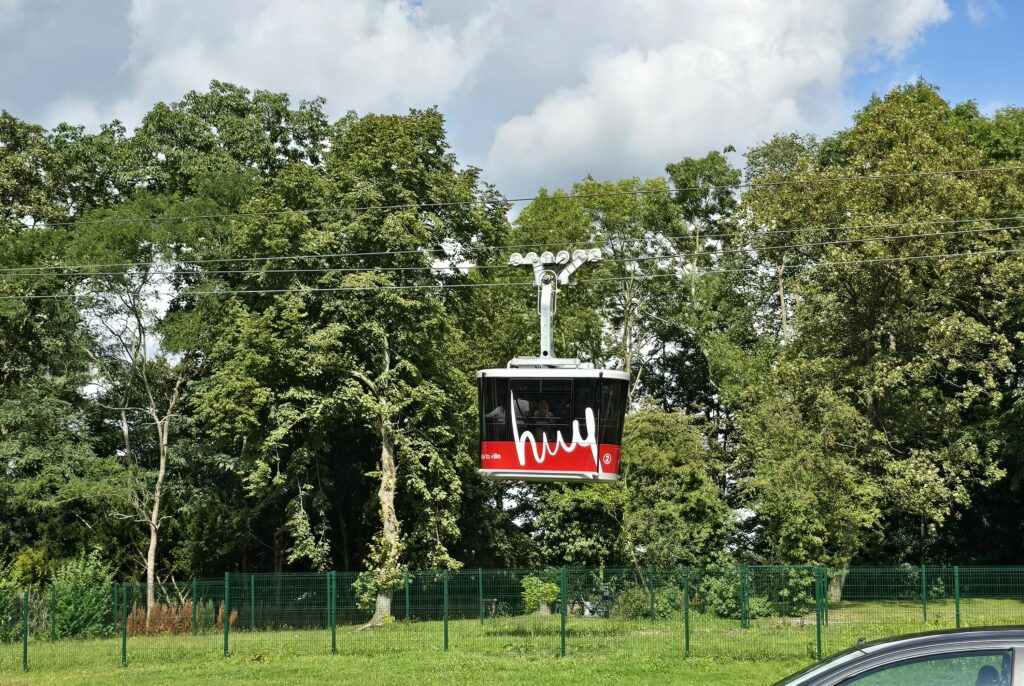
Between 1957 and 2012, a cable car allowed visitors to fly over the town of Huy, with a stop planned above the fort. Unfortunately, on April 6, 2012, a Robinson R22 helicopter cut one of the cable car’s cables. Following a call for tenders by the city of Huy, the cable car renovation work was entrusted to an architectural firm called U’MAN and a consulting firm called ERIC. This work began in September 2020.