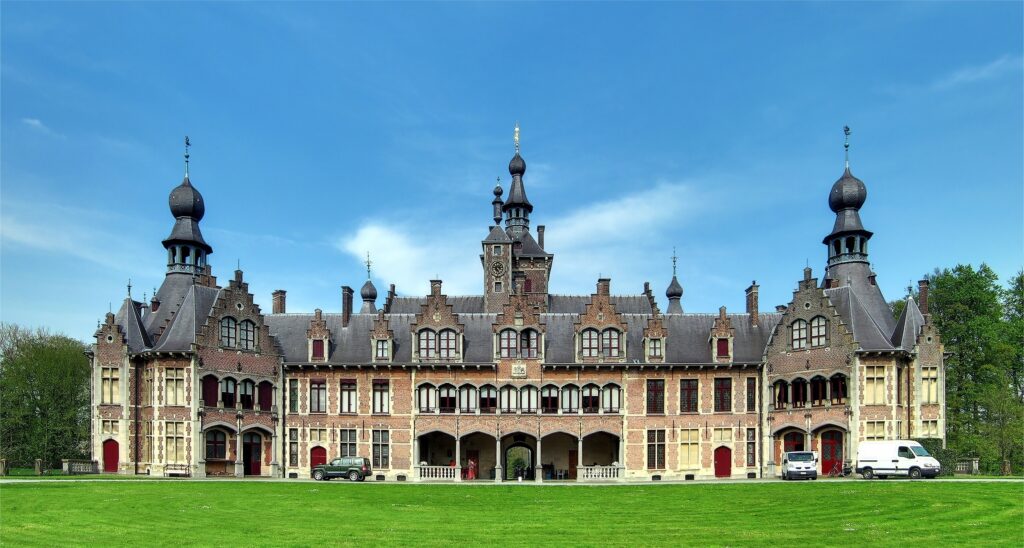
Located between Ghent and Deinze, Ooidonk Castle is one of the most beautiful castles in Flanders — a true jewel of Hispano-Flemish Renaissance architecture surrounded by water. With its elegant towers, wide moats and impeccably maintained estate, it offers a fairy-tale setting. Still inhabited today but partially open to the public, the castle charms visitors with its striking architecture, the peaceful atmosphere of its gardens and the stunning landscapes around it.
Galerie photos
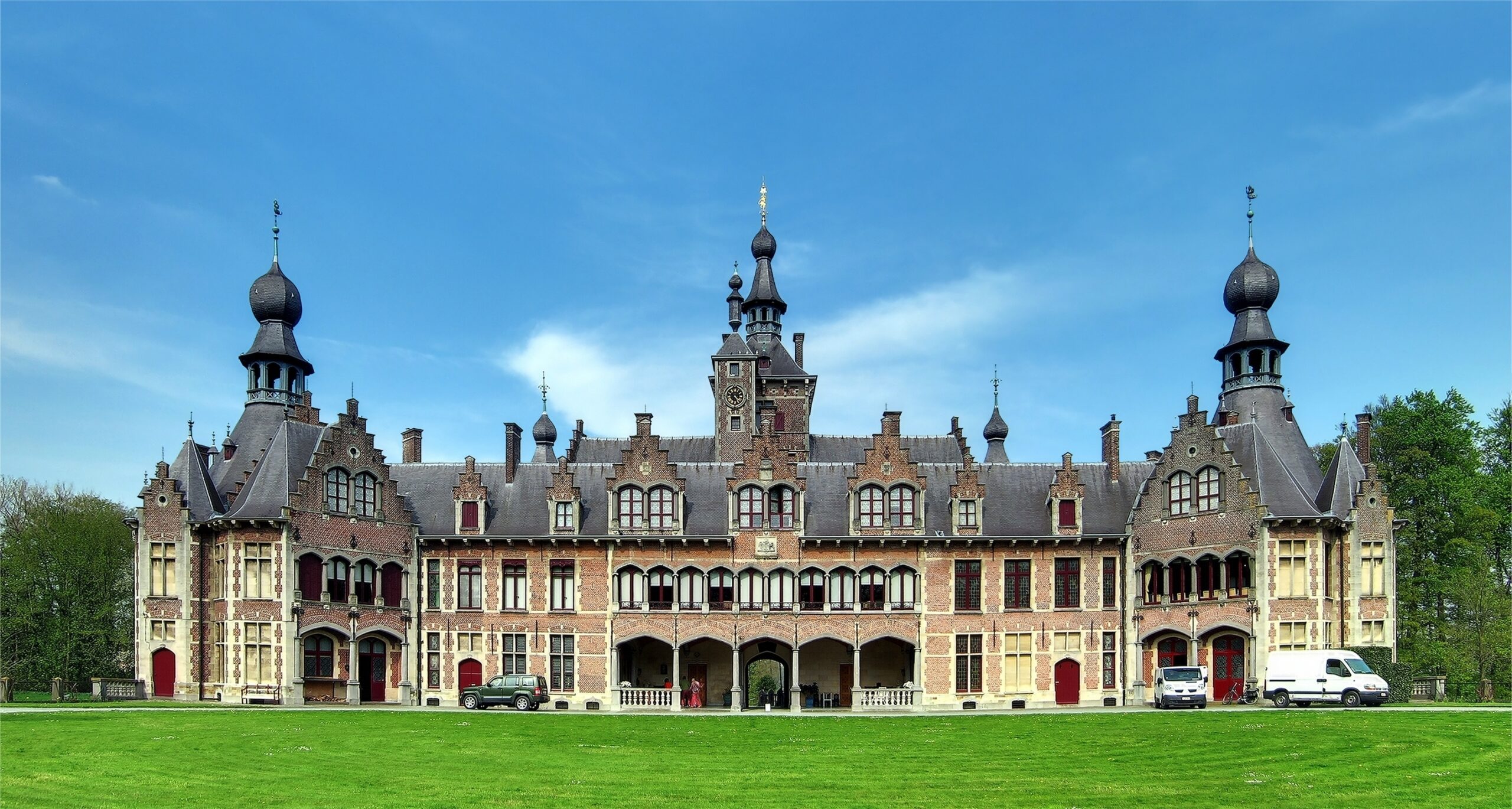
Velvet, CC BY-SA 3.0, via Wikimedia Commons
History of Ooidonk Castle
The first mention of Ooidonk dates back to 1230, referring to “Nicholas, chaplain of Hodunc.”
Originally a fortified farm, Ooidonk later became the residence of Jean de Fosseux, Lord of Nevele, who transformed it into a fortified castle with four corner towers (still visible today). Together with Laerne, Poucques and Gavere, it formed a network of fortified estates surrounding Ghent.
The castle was destroyed for the first time in 1491 by the people of Ghent during their revolt against Maximilian of Austria.
In 1568, Philippe de Montmorency, Count of Hornes and Lord of Nevele, owner of the estate, was executed alongside the Count of Egmont by the Duke of Alba in Brussels.
In 1579, during the Wars of Religion, the castle—left undefended—was destroyed again by the Calvinists of Ghent.
The ruins and surrounding lands were later purchased by Martin della Faille, a prominent Antwerp merchant conducting business throughout Europe. He rebuilt the castle in a Renaissance spirit and transformed it into a Hispano-Flemish style residence.
In 1864, the castle and its surrounding lands were acquired by Henri t’Kint de Roodenbeke, who would become President of the Senate and Minister of State.
Today, it is privately owned by Count Henry t’Kint de Roodenbeke, son of the late Count Juan t’Kint de Roodenbeke. The family has owned the castle since 1864, when their ancestor Henri t’Kint de Roodenbeke purchased it and expanded it without altering its Renaissance character.
In 1944, the castle was classified as a protected monument. Additional buildings were listed in 1980, and the entire estate received heritage status in 1995. Ooidonk Castle is open to the public from April 1 to September 15, while the park (a French-style garden) can be visited all year round.
The castle houses a notable collection of cabinets—furniture that first appeared during the Renaissance—including fine Florentine and Antwerp pieces.